

By VidMira · November 4, 2026
NJ road signs are made in different shapes and colors so that each one sends a particular message (Driver Manual, p. 213). This guide walks through that color and shape code from the New Jersey Driver Manual, then covers traffic signals, pavement markings, work zones and railroad crossings. The knowledge test many people call the NJ DMV permit test is given by the New Jersey Motor Vehicle Commission (NJ MVC).
Is there a separate road sign test in New Jersey?
No separate road-sign test is mentioned on the NJ MVC's own pages. The car knowledge test has 50 questions, and you pass with 40 correct (80%). In our app, road signs are studied as part of that test's topics.
The three kinds of New Jersey traffic signs
The manual divides signs into three basic categories (Driver Manual, p. 213):
- Warning signs warn you of hazards ahead that are difficult to see.
- Guidance signs guide you to a destination by clearly identifying the route.
- Regulatory signs regulate traffic speed and movement.
Sign colors and shapes: what each one means
The manual's sign table (Driver Manual, p. 214) works like a code:
| Color and shape | Sides | Meaning |
|---|---|---|
| Red octagon | 8 | STOP signs only |
| Red triangle | 3 | YIELD signs |
| White vertical rectangle | 4 | Regulation, such as speed signs |
| Green rectangle | 4 | Direction guidance |
| Blue rectangle or square | 4 | Motorist services and information |
| Brown rectangle | 4 | Public recreation and scenic guidance |
| Yellow diamond | 4 | Roadway hazard and railroad crossing warning |
| Orange diamond | 4 | Construction and maintenance warning |
| Yellow pennant | 3 | No-passing warning |
| Yellow pentagon | 5 | School signs |
| Yellow round | none counted | Railroad crossing advance warning |
| White X | none counted | Railroad crossing |
Examples of New Jersey traffic signs from the manual, with the meaning the manual gives:


When the safe speed for a curve or turn is lower than the posted limit, an advisory speed sign is added to the warning sign (Driver Manual, p. 214).
Regulatory signs
Regulatory signs are generally rectangular, with the longer side vertical, and have black wording and a black border on a white background (Driver Manual, p. 215). STOP is a red octagon with white wording; at a STOP sign, come to a complete stop. DO NOT ENTER is a white square with a red circle, a white band across the circle and the words DO NOT ENTER in white (Driver Manual, p. 216). Signs such as No U-Turns and No Right Turn show a black symbol inside a red circle with a slash (Driver Manual, pp. 221–222).
Speed limit signs are regulatory signs. New Jersey's top speed limits are (Driver Manual, p. 62):
- 25 mph in school zones and business or residential districts
- 35 mph in suburban business and residential districts
- 50 mph on non-posted rural roadways
- 55 mph on certain state highways (as posted) and interstates
- 65 mph on certain interstate highways (as posted)
Warning, guidance and service signs
Warning signs are yellow and diamond-shaped with a black symbol or word message (Driver Manual, p. 214). They alert you to things like deer crossings, school crossings or curved roadways; when you see one, use caution.
Guidance signs identify destinations and routes (Driver Manual, p. 215). Motorist service signs have white letters or symbols on a blue background (Driver Manual, p. 215). Pedestrian crossing and bicycle warning signs may be standard yellow or an optional yellow-green, and they tell you to share the road with pedestrians and bicyclists and yield to them (Driver Manual, p. 213).
Traffic signals
On a vertical signal, red is always on top, yellow is in the center and green is third. A green arrow is always on the bottom. On a horizontal signal, red is always on the left (Driver Manual, p. 212).
- Steady red: stop before the intersection or crosswalk and stay stopped until the light turns green.
- Steady yellow: stop before entering the intersection or crosswalk, unless you are so close that you cannot stop safely.
- Steady green: go, but yield to pedestrians and vehicles still in the intersection, and yield to approaching vehicles before a left turn.
- Flashing yellow: slow down and proceed with care.
- Flashing red: stop, yield to traffic and pedestrians, and go only when safe.
If a signal has no working bulbs and no one is directing traffic, treat it as a four-way stop (Driver Manual, p. 213). A police officer can overrule traffic signals (Driver Manual, p. 211).
Pavement markings
Road markings have the same force of law as signs or traffic signals (Driver Manual, p. 216).
- Yellow center lines separate traffic going in opposite directions. White lines separate lanes going the same way and show the edges of roads.
- A dashed line on your side of the center line means you may pass when safe. A solid line on your side means do not pass.
- White stop lines show where to stop. If there is no stop line, stop before the crosswalk when signs, signals or pedestrians require it (Driver Manual, p. 217).
- White diamonds mark high occupancy vehicle (HOV) lanes (Driver Manual, p. 217).
Work zones
Road work signs are orange diamonds that warn of lane closings, lane shifts, flaggers, uneven pavement and detours (Driver Manual, p. 215). Reduced speed limit signs are posted alongside them, and in New Jersey all traffic fines are doubled in work zones. Flaggers have the same authority as a regulatory sign, so you can be cited for disobeying their directions.
Railroad crossings
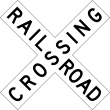
The crossbuck, an X-shaped sign with black wording on a white background, means the same as a Yield sign. Always yield to trains: they cannot swerve to avoid you (Driver Manual, p. 216). A round yellow sign warns that a crossing is ahead, and white R X R markings on the pavement do the same (Driver Manual, pp. 217, 222).
Some crossings also have flashing red lights, bells and/or gates (Driver Manual, p. 217). Flashing red lights mean a train is coming; go only when the lights stop flashing and all other active warning devices turn off (Driver Manual, p. 212).
Sample questions
From the app's practice questions:
- How many sides does a STOP sign have? Answer: 8. STOP signs are red octagons with 8 sides (Driver Manual, p. 214).
- What does an orange diamond-shaped sign warn about? Answer: Construction and maintenance. Orange diamonds are construction and maintenance warning signs (Driver Manual, p. 214).
- A five-sided (pentagon) sign tells you that you are near what? Answer: A school. Yellow pentagons are school signs (Driver Manual, p. 214).
- What do flashing red lights at a railroad crossing indicate? Answer: A train is approaching and you must yield to it. Flashing red lights at railroad crossings indicate an approaching train, and motorists must yield to the train (Driver Manual, p. 212).
- Which basic category of sign warns motorists of hazards ahead that are difficult to see? Answer: Warning. Signs are divided into warning, guidance and regulatory categories; warning signs warn of hazards ahead that are difficult to see (Driver Manual, p. 213).
Signs are only one part of the manual; our New Jersey Driver's Manual study guide covers the rest.
Practice with the app
NJ DMV Permit Practice Test has a road signs section where you see each sign large with its description and practice the questions that show it, plus a road signs quiz. Each answer explains why, with the manual page, and you can study in English or Spanish. Everything in the app is free, with no subscription and no in-app purchases. Get NJ DMV Permit Practice Test.
Sources
- New Jersey Driver Manual (2026 edition), NJ MVC
- NJ MVC: Knowledge test and Sample knowledge test
Checked against the New Jersey Driver Manual (2026 edition) on November 4, 2026. Rules can change; the NJ MVC's own pages at nj.gov/mvc always win. NJ DMV Permit Practice Test is an independent study app by VidMira LLC. It is not affiliated with the New Jersey Motor Vehicle Commission or any government agency.
More New Jersey permit test guides
All New Jersey permit test guides
VidMira LLC is not affiliated with the New Jersey Motor Vehicle Commission (NJ MVC) or any government agency.